You are here: Home arrow Artists arrow Composers arrow Brody, James [Composer]
  • Decrease font size
  • Default font size
  • Increase font size
James Brody [Composer] Discography

Bio

James Brody (b.1941) studied composition at Indiana University with Iannis Xenakis and Franz Kamin. Brody wrote the liner notes for the original Nonesuch LP of 'Iannis Xenakis - Electroacoustic Music'. He was co-founder of the FIASCO group in Bloomington Indiana and CAPASA in San Antonio (both organizations dedicated to presentation and performances of works by local composers and other artists). In 1970, he taught composition, theory and electronic music at East Texas State University. He has written many electroacoustic and instrumental works. The following works have been presented at the annual International Computer Music Conference(s) (ICMC): Barzakh for tape (1984), 7-1-7…for tape (1996), Background Count, percussion and tape (1998), Syllepsis - Hommage à Iannis Xenakis (2002). Traces for solo woodwinds and brass, piano, harp, percussion and strings was commissioned and performed by the Harrisburg Symphony in 1994. Theta Ticker was performed at the IV Brazilian Symposium on Computer Music, August 1997 and the Beckonings series at Stanford University, June 1999. and A Glance into the Garden for flute and tape was played at SEAMUS 2000. Brody was a guest composer at the Electronic and Computer Music Studio of The Peabody Institute and is an active member and past president of the Baltimore Composers Forum. Brody currently resides in Central Pennsylvania. Background Count was recently performed at the Kennedy Center in Washington, DC as part of a concert of the SONIC CIRCUITS International Electronic Music Festival. Several of Brody's works are available for audition through the Collective Jukebox Project, now playing at the Mamco (Musée d’art moderne et contemporain), Geneva. Syllepsis was played on a concert at MAXIS, a Festival of Sound and Experimental Music, Sheffield Hallam University, Sheffield, England, Spring 2002. DRD4 for flute, clarinet, contrabass and piano, based on the genetic code, was performed by Washington Musica Viva in 2003. Techqua Ikachi!, for four channel electroacoustics, four instrumental groups, chorus, singers and actors with a text by Frederick Schreiner based on the Hopi story of creation, was premiered at York College of Pennsylvania in 2004. Currently Brody is a member of the adjunct faculty of York College of Pennsylvania.

Interview p.1

In the early 1970s, James Brody was an aspiring composer on the verge of a brilliant career. Having studied composition at Indiana University with Xenakis, Brody was an authority on electro-acoustic and stochastic methods, writing the liner notes for the original Nonesuch LP 'Iannis Xenakis - Electroacoustic Music'. He was awarded a position in composition, theory and electronic music at East Texas State University…and then he disappeared.

Tomorrow is Yesterday: James Brody talks about music… and the peculiar influence of time travel.
By Marc Wolf

I know of many composers who left the music scene to pursue other careers; can you tell us what prompted you to ‘drop out’, and what influence your time away from the music scene had on you and your process of composition?

Besides raising a family, I was involved in several businesses. The first was a restaurant in San Antonio, Texas. It was a natural food restaurant and health food store. It was a tremendous social ‘experiment’ that lasted about 5 years. Most of the people who worked there were young people, associated with various spiritual paths and movements, about 22 people at any given time. It was a bit like working in a giant pressure cooker; a poet who worked there (Naomi Shihab Nye) wrote a song about the place which began: "I'm living in a circus...." It was a lot of fun and incredibly hard work.

Other businesses have been computer-related and right now I am very interested in all kinds of recognition technologies, especially speech recognition.

The result of the involvement with these businesses has been that I did not compose for a very long time (one or two pieces in the 15 years between 1975 and 1990). In 1990, at the end of a particularly difficult marriage, I moved to Baltimore and decided to start composing again in earnest. One break during this time was that I was commissioned to write a piece for the Harrisburg (PA) Symphony which was subsequently performed in 1994. At the same time as moving to Baltimore I met Dr. Geoffrey Wright of the Peabody Conservatory who invited me to be a guest composer in the Peabody electronic music studio where I first took advantage of the many advances in personal computers that allowed for a flexibility in the handling of sound which was almost impossible in the early days of electronic music. After the involvement with Peabody I was able to set up a personal studio along these lines and entered into one of the more productive phases of my musical life.

Interview p.2

What is your earliest musical memory?

I listened to a lot of music as a child, it was like in a reverie, listening to the radio or records, lying on the living room floor sometimes listening to children's records, sometimes listening to symphonies or concertos or chamber music…Whenever I hear certain music of Rachmaninoff, it reminds me of that time. My mother loved modern music and introduced me to works of Schoenberg and Stravinsky.

How did you start composing?

I first started composing in the mid-60s as the result of meeting my lifelong (from that point on) friend and composition teacher, Franz Kamin. After numerous discussions about music, life, and many other subjects, he said to me, (I was studying musicology) "it's really stupid just to study other people's music, you have to write some of your own." We were both enrolled in some of the composition seminars at Indiana University and then we started these weekly meetings called 'Fiasco' where artists, composers, poets, painters, creative artists of all kinds would bring their works and present them for the enjoyment and critique of their peers. This provided plenty of opportunity to create short works, a way to try them out, get feedback, and then go on to something new.

How do you determine when a work is finished? In other words, when are you satisfied that the process is complete?
I drift in and out of satisfaction with my work. It is almost as if there are two people, the one who thinks of musical possibilities and the one who works them out one at a time. I know there are certain places in my music that I'm glad I wrote, each for different reasons, some more emotional, some more that I was able to realize some kind of particular event in a sound world that I was creating.{tab=Interview p.3}
Tell us about what kind of music you like, and what has had an influence upon your work.

Different musics at different times in my life are important to me. I guess I find that some music is for me what I call 'generative'. What this means is that I listen to the music and there is another music going on the same time. The other music is, of course, my music. Examples of this are Milton Babbitt, Elliott Carter, Zia Muhyiuddin Dagar, Webern, Bach... etc. You see a pattern there? Perhaps it's a kind of intricacy. I don't know for sure.

I was very much influenced by the sound world of Iannis Xenakis and it is an influence for which I am grateful and which I need to struggle with as time passes, not because the sound world is bad but because I must keep creating my own.

As far as favorite composers, in addition to those already mentioned, I might say Mahler, Stravinsky, Jerry Hunt, individual works by many composers, Mozart, Stockhausen, Josquin, music of many periods, many countries, Risset, John Adams, Beethoven, Brahms, the Beatles.

The music of Franz Kamin, almost completely unrecognized to this point, provides, for me, solutions to many of the questions and problems of 20th-century music, and has made a deep impressionon me. The music itself is inimitable, so I don't try to imitate it, but the ideas behind it lead far beyond the music.

In "The Enclosed Garden", one reader intones a Kaballistic text and another reader follows a series of 3 by 5 cards each one with a highly charged emotional phrase on it. All this is accompanied by an ensemble of piano, cello, slide whistle, percussion made up of junk and kitchen utensils.

Interview p.4


Another piece called "Behavioral Drift 2" for large ensemble is one of a few pieces that solves the “20th-century problem” of presenting a complex and transforming texture, while preserving the perceptibility of events.

Another very early work, "Structures I" for Chamber Orchestra is a piece where silence is structured between short events in such a way that the sound of the events carries through the silence as a kind of after image. Each of the events has in itself a part in a structure of 'meaning'.

You spent a great many years away from the classical music scene. Do you have any comments on how it feels to hear your compositions performed after this hiatus?

It is indeed very exciting; a whole new experience with many mixed emotions.
I still feel like I'm learning something with every piece that I write. In fact, in some strange way, I have to learn how to compose all over again with each piece. It's surprising to listen to old pieces and find that I actually have a style.

What is the process of composing like for you, and what are you working on currently?

It is perhaps one of the most exhausting activities I can do. There are decisions to be made at every instant. One even has to consider whether one is falling into one's own cliches. Constantly monitoring for form and content, applying what ever rules are set up for the piece, monitoring for appropriateness, interest, surprise, boredom, truth to the idea of the work, receptivity to the idea that one has not yet thought of for the piece.... You might think that I don't like this activity. But not only is it exhausting, it is also regenerating and necessary, and I get very strange if I don't do it for a long time…right now I am revising a piece for electroacoustic sounds and three trumpets (spaced around the audience).

What was the most important performance of a work for you?

The orchestral performance mentioned above was kind of a watershed in my career. Also pieces of mine have been chosen for performance at International Computer Music Conferences in 1984, 1997, 1998 and 2002 (still to come, in Gothenburg Sweden) as well as the performance at the SEAMUS conference of 2001 and this gives me some kind of feedback that my peers in the electroacoustic music community recognize that my music has some qualities that they can take note of.

All the performances under the auspices of the Baltimore Composers Forum give me a feedback from piece to piece that is important for my ongoing compositional effort. I've been very active in the Baltimore Composers Forum in terms of both administration and participation. The forum has been active since 1993 in presenting new works by Baltimore composers.

Interview p.5


In the summer of 2001, "Background Count" for percussion and electroacoustic sounds was performed at Kennedy Center in Washington DC as part of the series of Sonic Circuits Concerts.

What do you do in addition to composing?

I collect LP records, still certain that LP records, even the worst of them, have better sound than compact discs and gives me a chance to listen to all kinds of music. Also, the art of recording instrumental music reached a peak in the mid-to-late fifties and early '60s, and has been in the decline up till recently. Along with that I am fanatical about good audio equipment because the quality of the sound is important to me. Most sound enforcement equipment used in live performances these days sounds horrible and abusive to the listener, yet people just love it.

My interest in mysticism, especially from the Middle East, has led me on some very interesting journeys through life.

Is there anything you can tell us about "A Glance into the Garden"?

The piece was commissioned by the Baltimore Composers Forum to be auctioned off after a performance at an art gallery, a benefit reception for the forum. Pieces by three different composers were played and there was bidding for the piece, actually bidding by someone to have a yet another piece composed for them. It seemed that none of the people who came to the reception at the gallery had any idea that having even an insignificant composer write a piece for them was worth much. Eventually, after much badgering from the auctioneer, a church organist from Baltimore bid to have all three composers write a piece for him. Each of three composers was asked to write a piece somehow to accompany or convey the meaning or significance of one of the works by one of the three artists currently being shown at the gallery. The work that I chose was called "The Enchanted Garden" by Nancy Scheinman and is a triptych showing a commedia dell'arte scene and a formally dressed dancing couple in a dream embrace. How to set a visual scene to music?... There was a Pierrot figure balancing a golden hoop on the end of a stick and this suggested a metallic sound with an echo. Well, that was all I needed to get started and the rest of the sounds arose from that to create a dreamlike atmosphere. I composed a three-minute electroacoustic section and then set to work on a flute part. Strangely enough, and I don't know if I've told very many people this, I started to think of the original Star Trek episode where they are suddenly catapulted back in time and are seen by an Air Force pilot. They have to beam the pilot out of his airplane, beam themselves into the Air Force Base, remove the records of the pilot's sighting, and beam the pilot back into his airplane at a time before the sighting so he doesn't remember.

Yes, actually that episode is called “Tomorrow is Yesterday”; I believe they had a near-collision with a black hole or something…

There's a recurring musical motive in this episode, which I kept hearing while I was composing "...Garden" so I created a tone row containing this motive and wove it into the flute part. As far as timing the flute part and he electroacoustic part, I marked the score with the tempo and a starting indication such that if the flute player were in tempo, she would end at the appropriate time. This particular piece has enjoyed more performances than any other that I have written.

Can you tell us anything about your upcoming release for the Furious Artisans label?

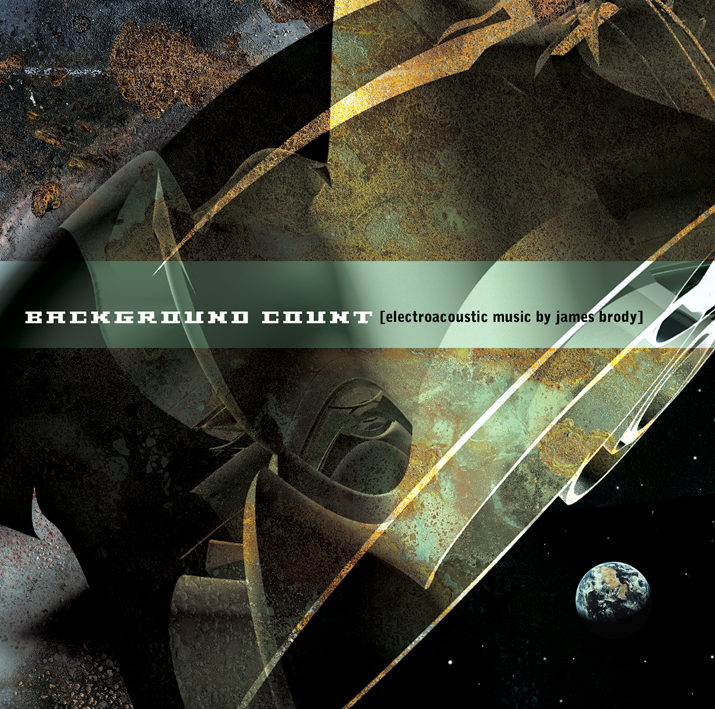
Yes, the album is called “Background Count: Electroacoustic Music by James Brody”. It is due out in August, and will include mostly recent compositions. The great thing about working with FA is they have the same commitment to high fidelity as I do, so I feel confident that the sound quality will be impeccable.

Where can interested parties learn more about you and your work?

The best thing to do is to do a google search under James Brody, and you can find my website.

Works List

1965
Seven Haiku for Soprano and String Quartet
1966
Piano Trio
Seven Temporal Ectostructures for Piano
Transformations, a duo for violin and cello
1967-1969
Interplace for tape
Miralia for tape
Yaft for tape
Wei Wu Wei for tape
Fornandltiminzit for tape
1970
Salat for tape
1978
When? Now!
Hold the Moment in your mind,
See how it extends beyond you....for soprano and bass voices with chamber ensemble (Setting of haiku by Michael Satterfield)
1983
Barzakh for tape
1989-1990
Traces for Orchestra
1992-3
Intersect for tape
1992-1999
Melencholia for 41 Speaking voices and 16 instruments (in progress)
1994
The Man Who was Always Standing There for 3 Speakers, flute, harpsichord and trombone
7-1-7... for tape
1995
Entrainments for tape
1996
Filaments for 2 flutes and bassoon
Theta Ticker for tape
1997
Background Count for percussion and tape
Time Slice I for 3 trumpets and tape
1998
44544 for string quartet
Dialog for viola and cello
A Glimpse into the Garden for flute and tape
1999-2000
Turning for tape
Syllepsis for tape
2001
What is the Question for flute, tenor saxophone and piano


Discography


Homepage:
http://members.bellatlantic.net/~brody371/

 
< Prev   Next >